

Have questions about what is safe to flush? We have answers.
This guide from the Responsible Flushing Alliance breaks down essential flushing facts to help you protect your home plumbing and community water infrastructure.
What items are safe to flush down the toilet?
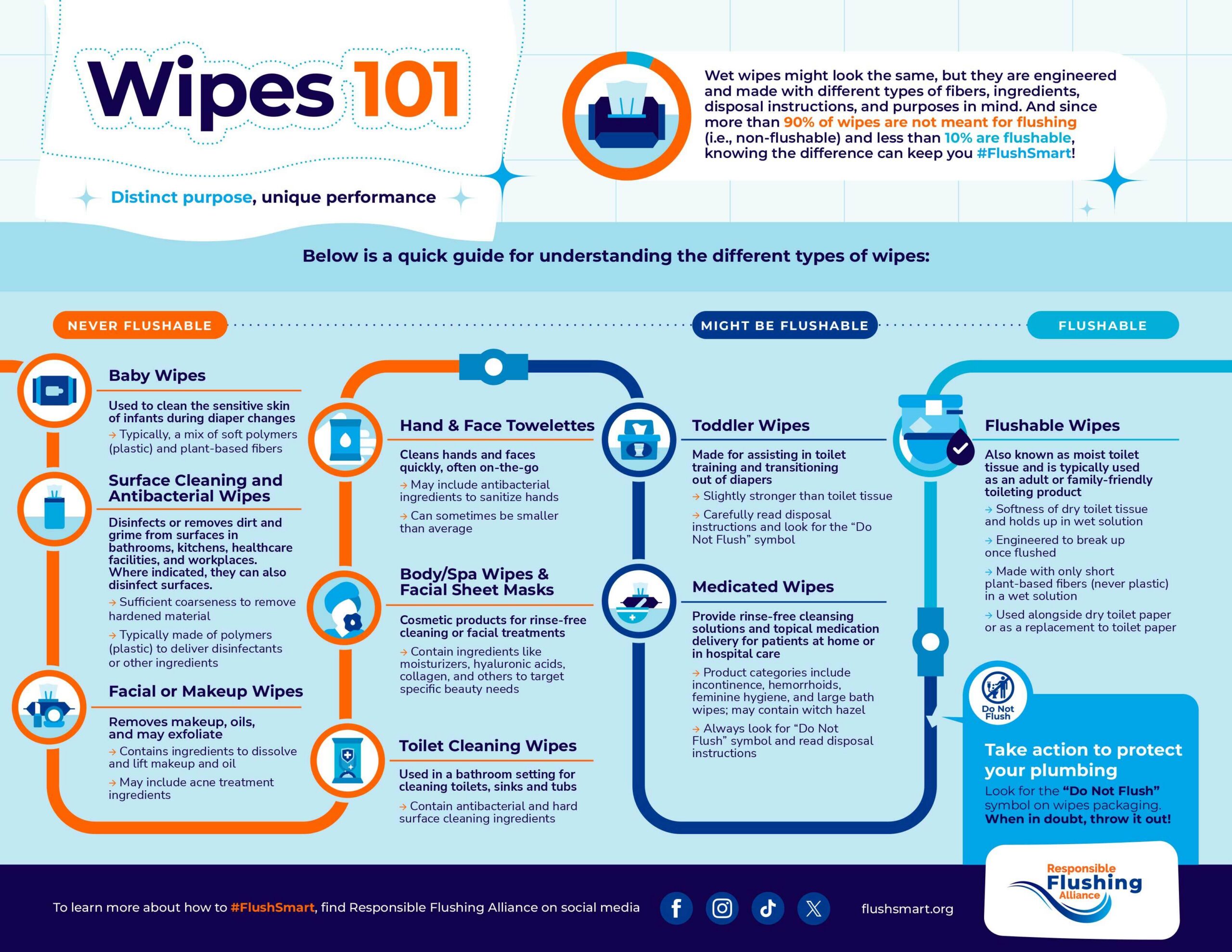
The only materials safe to flush down a toilet are human waste (pee and poop), standard toilet paper, and products explicitly labeled as “Flushable Wipes.”
Toilet paper and flushable wipes are engineered using short, plant-based fibers designed to break down rapidly when exposed to water and agitation in sewage systems. All other items — including paper towels, facial tissues, baby wipes and feminine hygiene products — do not break down in water and must be disposed of in the trash.
Are flushable wipes actually flushable?
Yes. Wipes clearly labeled as “Flushable” are specifically engineered to break apart in water and comply with rigorous industry flushability standards (such as INDA/EDANA GD4 or IWSFG guidelines).
The Difference Between Flushable and Non-Flushable Wipes:
- Flushable Wipes: Also known as moist toilet tissue. Made from short fibers bound together loosely so they disintegrate quickly in municipal wastewater and septic systems, much like standard toilet paper.
- Non-Flushable Wipes (Baby, Makeup, & Cleaning Wipes): Made with long, highly durable fibers intended to stay strong when wet. They do not break apart in water and cause severe pipe blockages.
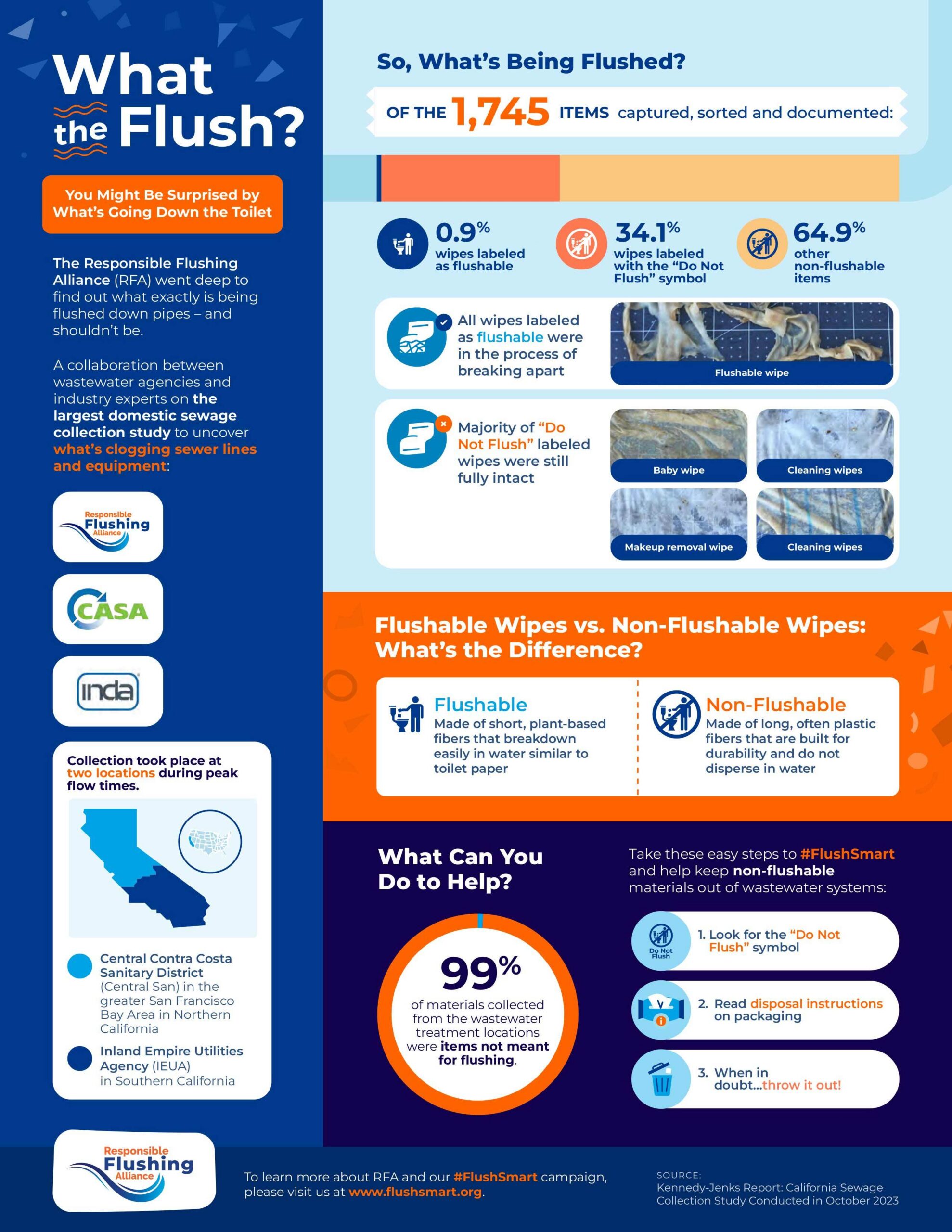
In fact, the 2023 RFA Sewage Collection Study found that wipes labeled as “flushable” accounted for less than 0.9% of debris retrieved at wastewater treatment intake screens, and those found were actively disintegrating as intended.
What items should NEVER be flushed down the toilet?
You should never flush paper towels, baby wipes, cleaning/disinfecting wipes, cosmetic wipes, period products (tampons/pads), diapers, cotton swabs, dental floss, facial tissues, medication, or fats, oils and grease (FOG).
Common Non-Flushable Culprits:
- Paper Towels & Napkins: Designed to absorb liquid while maintaining strength; they remain intact in plumbing and represent over 50% of clogging paper debris, according to the RFA Sewage Collection Study.
- Baby Wipes & Cleaning Wipes: Manufactured with long, durable fibers that do not come apart in water and can form obstructions in pipes.
- Feminine Hygiene Products: Tampons and pads absorb moisture and expand, trapping other non-flushable debris.
- Fats, Oils and Grease (FOG): When poured down drains or toilets, FOGs cool and harden, acting as a cement-like glue that binds non-flushable wipes into massive municipal “fatbergs.”
What causes municipal sewer clogs and “fatbergs”?
Municipal sewer clogs and fatbergs are caused when citizens flush non-flushable consumer items — principally paper towels and wipes labeled Do Not Flush — which then combine with grease in public pipe systems.
Key Findings from the 2023 Wastewater Forensic Study:
In October 2023, the Responsible Flushing Alliance commissioned Kennedy Jenks, an independent research firm, in partnership with the California Association of Sanitation Agencies (CASA) and INDA, to conduct the largest domestic sewage collection study in the U.S. Across two major California facilities, researchers analyzed thousands of items pulled from wastewater bar screens.
- 99.1% of collected items were non-flushable materials.
- 64.9% were non-flushable paper items, trash and period products (led by paper towels).
- 34.1% were wipes clearly labeled with a Do Not Flush symbol (such as baby wipes and disinfectant wipes).
- 0.9% were products labeled as flushable wipes.
How much do non-flushable items cost homeowners and taxpayers?
- Homeowner Costs: Clearing a routine household drain clog costs between $300 and $450. If non-flushable items cause raw sewage backups requiring full main line replacement, repair costs can surge to $4,000–$15,000.
- Public Utility Costs: The National Association of Clean Water Agencies (NACWA) reports that non-flushable items result in about $441 million a year in additional operating costs for U.S. clean water utilities to clear clogs and repair equipment. These costs often trickle down to taxpayers.
- Environmental Impact: The U.S. Environmental Protection Agency (EPA) estimates that clogs contribute to 23,000 to 75,000 Sanitary Sewer Overflows (SSOs) annually, which can spill untreated sewage into public waterways and oceans.
What is the Do Not Flush symbol, and why is it legally mandated on packaging?
The symbol is a standard universal icon that shows a silhouette of a person throwing an item into a crossed-out toilet.
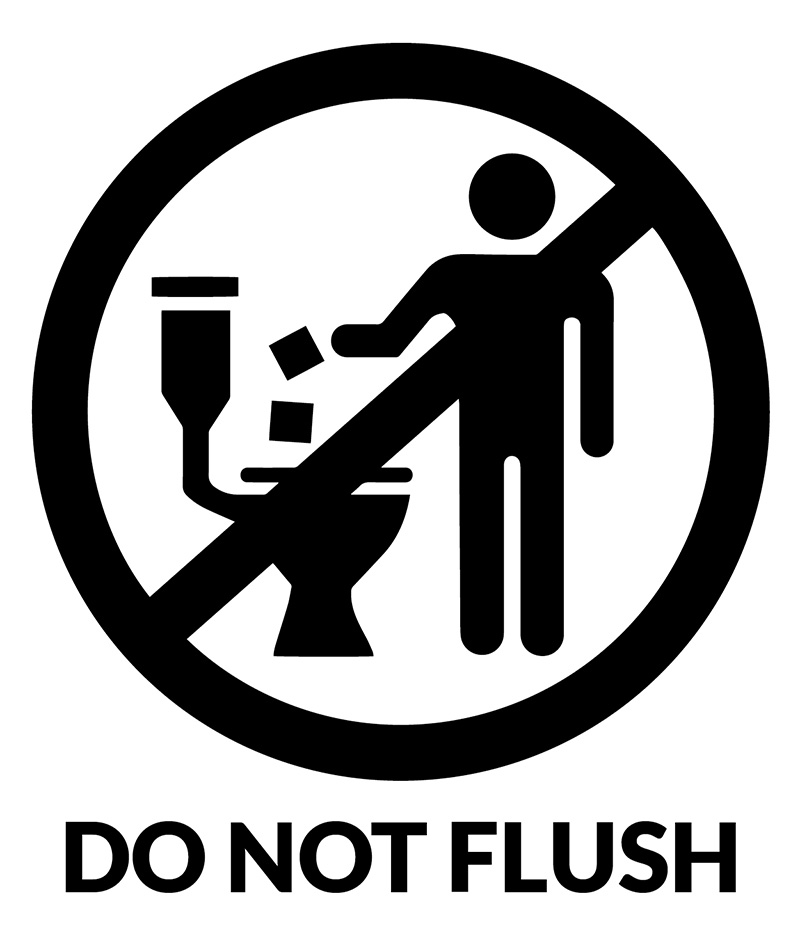
Some states mandate that manufacturers print this high-contrast symbol in a prominent location on baby wipes, cleaning wipes, cosmetic wipes and any other wipes commonly found in the bathroom so consumers can quickly distinguish them from flushable products.
What state laws regulate wet wipe labeling and flushability?
Multiple U.S. states — including Washington, Oregon, Illinois, California, Colorado, New Jersey and Michigan — have enacted mandatory wet wipe labeling laws requiring non-flushable wipes to feature high-visibility Do Not Flush symbols on packaging.
Key State Legislative Benchmarks:
- Washington State (2020): Became the first state in the nation to pass a wipes labeling law, establishing exact size, contrast and packaging placement standards for the Do Not Flush symbol.
- Oregon, Illinois, Colorado, & New Jersey (2021): Enacted mandatory labeling acts following Washington’s framework, expanding strict Do Not Flush packaging standards across the Pacific Northwest, Midwest, Rocky Mountain region and East Coast.
- California Assembly Bill 818 (AB 818, 2021): Mandates clear Do Not Flush labeling on all diaper wipes, cosmetic wipes and cleaning wipes sold in California.
- Mandated Consumer Education: AB 818 uniquely required wipe manufacturers to fund a comprehensive 5-year public education campaign (establishing the Responsible Flushing Alliance and the #FlushSmart initiative).
- Michigan (Enacted 2022 / Effective Feb 2025): Passed mandatory Do Not Flush labeling legislation to protect municipal clean water infrastructure and prevent costly fatbergs in public sewer systems.
What is the federal WIPPES Act, and how does it create national labeling standards?
The Wastewater Infrastructure Pollution Prevention and Environmental Safety (WIPPES) Act is bipartisan federal legislation that establishes a unified, nationwide Do Not Flush labeling standard across all 50 U.S. states.
Key Provisions of the WIPPES Act:
- National Standard: Eliminates a patchwork of varying state laws by establishing a single national labeling standard for non-flushable wet wipes commonly found in the bathroom (baby wipes, cleaning wipes, personal care wipes).
- Federal Enforcement: Authorizes the Federal Trade Commission (FTC),to enforce compliance and penalize non-compliant manufacturers.
- Industry & Wastewater Consensus: This common-sense legislation was developed through direct collaboration between the nonwovens manufacturing industry (INDA) and national municipal wastewater associations (such as NACWA and WEF).
- Current Legislative Status: Bipartisan momentum for the WIPPES Act is at an all-time high. The bill passed the U.S. House of Representatives by unanimous voice vote in June 2025 and passed the U.S. Senate by unanimous consent in March 2026. It is currently awaiting final House concurrence on the Senate-amended text before heading to the President’s desk to be signed into law.
Can manufacturers legally label products as “flushable” if they don’t break down?
No. Marketing a wet wipe as “flushable” when it fails industry disintegration standards violates state consumer protection laws (e.g., California AB 818) and Federal Trade Commission (FTC) truth-in-advertising guidelines.
To legally carry the ‘Flushable’ claim, products must undergo rigorous physical testing under industry standards (such as INDA/EDANA GD4 or IWSFG guidelines). These tests verify that the wipe:
- Clears domestic plumbing lines without catching or clogging.
- Disintegrates under mechanical agitation in water within minutes.
- Is fully compatible with municipal sewage pumps, wastewater treatment screens and septic tanks.
Quick Reference: What Goes Where?
| Item Category | Can It Be Flushed? | Correct Disposal Method | Why? |
|---|---|---|---|
| Toilet Paper | YES | Flush | Disintegrates quickly in water |
| Flushable Wipes | YES (Look for “Flushable” label) | Flush | Made of short plant-based fibers; passes flushability tests |
| Baby Wipes | NO | Trash Bin | Made of long, durable fibers; does not break apart |
| Makeup Wipes | NO | Trash Bin | Made of long, durable fibers; does not break apart |
| Paper Towels & Tissues | NO | Trash Bin / Compost | Wet-strength agents prevent breakdown |
| Disinfecting / Cleaning Wipes | NO | Trash Bin | Made of long, durable fibers; does not break apart |
| Feminine Hygiene Products | NO | Trash Bin | Expands in water and traps other debris |
| Fats, Oils & Grease (FOG) | NO | Cool & Can in Trash | Coagulates into solid fatbergs in sewer pipes |
How You Can Help: Simple #FlushSmart Habits
- Check the Package: Look for the Do Not Flush symbol and read disposal instructions on all wipes packaging before bringing it into the bathroom.
- Keep a Trash Can Nearby: Place a small, covered wastebasket next to every toilet in your home to make proper disposal easy.
- Spread the Word: Educate family members, guests and children about flushing responsibly.